

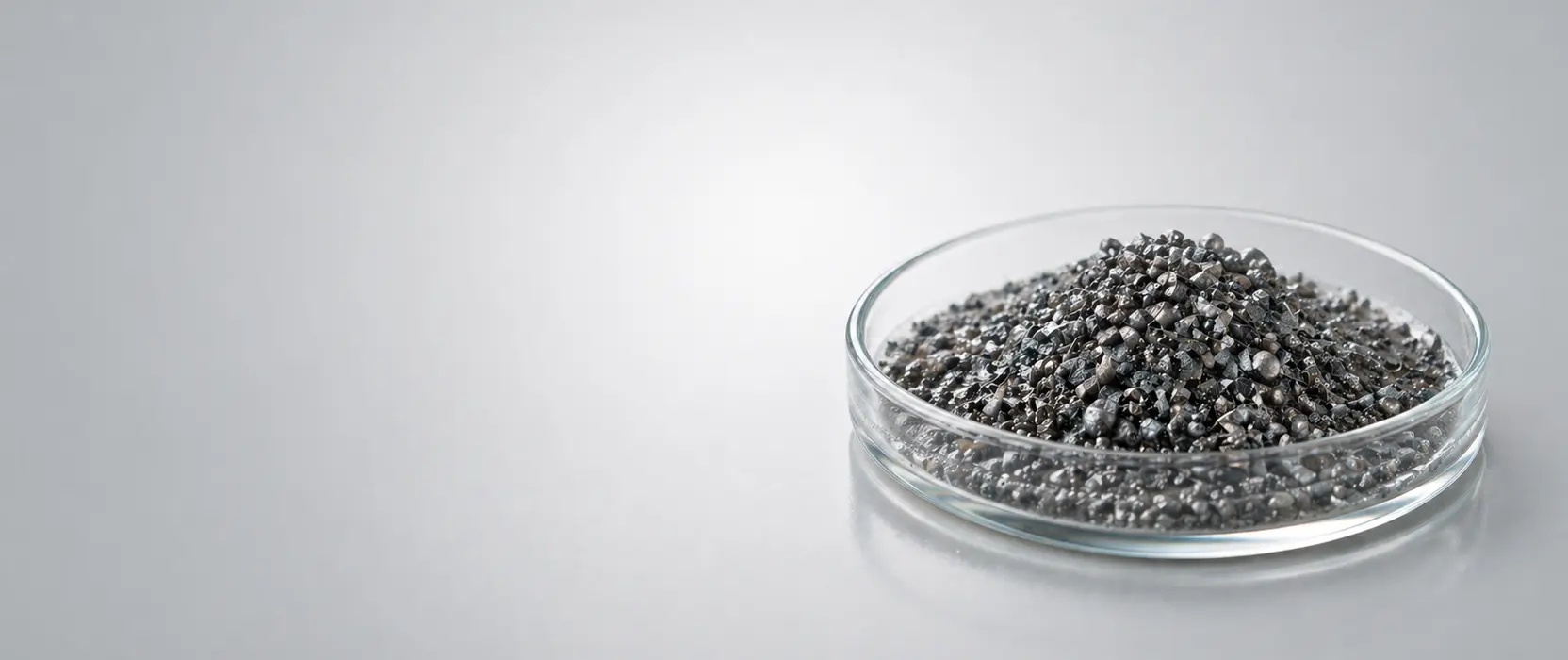
Blasting media: heavy, abrasive, bulky
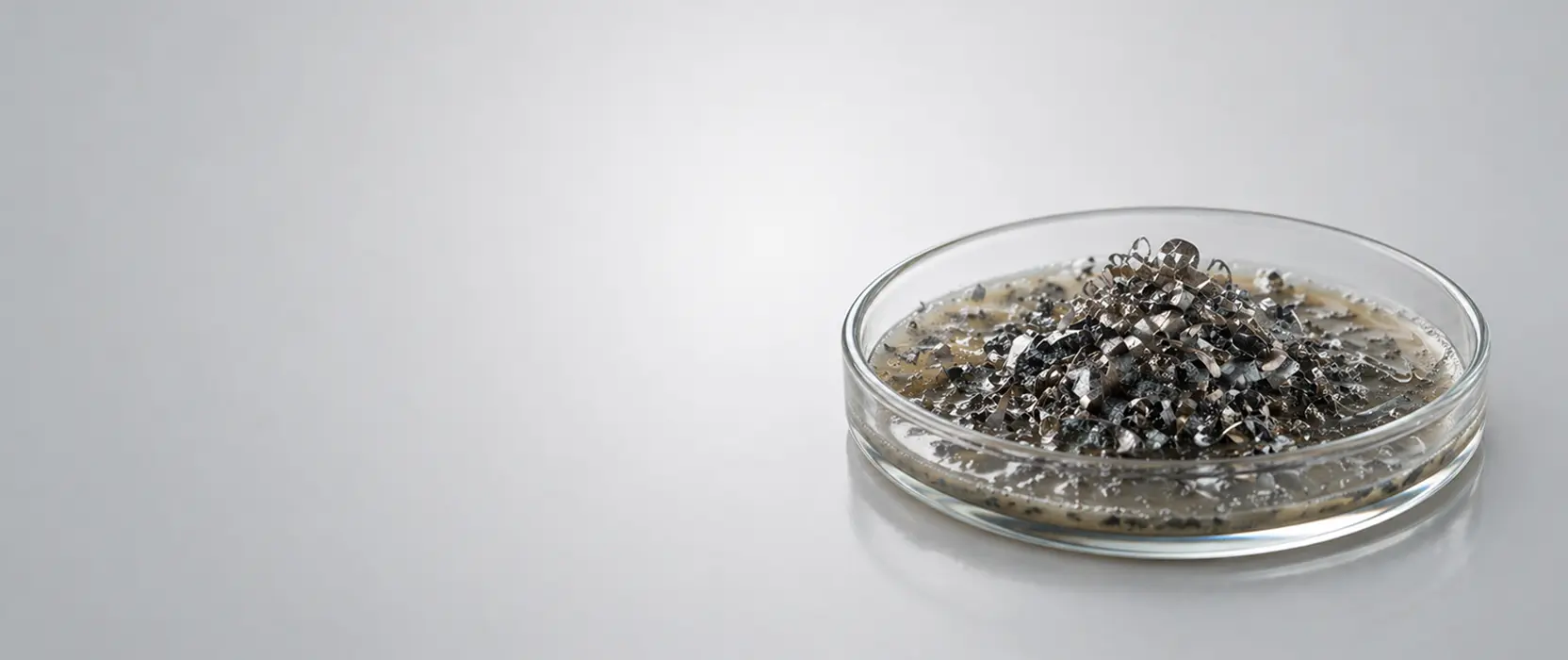
In blasting, surfaces are cleaned or treated through the targeted impact of blasting media. Depending on the application, steel shot, corundum, or other materials are used—materials that must have a certain weight to be effective. Upon impact with the component, part of the blasting media shatters. What remains is a mixture of broken blasting media residues and removed deposits—heavy, abrasive, and generated in significant quantities in industrial applications.
In cabinet systems, this material is usually automatically recirculated. However, those who process large-format components that do not fit into a cabinet face a different situation: The material settles on the shop floor and must be removed from there.
A hall as a workspace—and what that means for extraction technology
A company that refurbishes components for the shipping industry operates a blasting system that uses steel shot. The components to be processed are too large for a booth—the entire hall serves as the workspace. Rust, algae, and barnacle growth are removed there, and the shattered blasting media and deposits end up on the hall floor.
In such applications, it becomes clear that the demands on extraction technology go far beyond suction power alone. Heavy, abrasive material places significant mechanical stress on the housing, hoses, and separation unit. A vacuum cleaner designed for this application must not only be powerful—it must remain durable over the long term. It is often assumed that high suction power is the decisive factor for such applications. In practice, however, mechanical robustness and material handling are the actual keys to success.
What makes the DA 5150 M suitable for this task
In blasting applications of this scale, systems are required that are designed for high mechanical loads, large volumes of material, and continuous operation. The housing, air ducting, and separation unit must be constructed in such a way that even heavy and abrasive material can be safely handled over the long term.
For this application, the company uses a RUWAC DA 5150 M—a unit specifically developed for such heavy-duty applications. The housing, made of solid sheet steel, is designed to withstand mechanical stress. The suction capacity is appropriately sized to safely handle heavy and abrasive material.
An important design feature is the height-adjustable filter and separation unit. It allows the unit to be adapted to different disposal containers—in this case, a sturdy drum on a cart that is emptied via a tilting mechanism after filling. Especially in applications where large quantities accumulate after each blasting operation, this flexibility is not merely a convenience feature but a prerequisite for efficient operation.
The system is driven by a direct drive side-channel blower—a design that promotes energy efficiency and operates with low maintenance in continuous operation. The filter unit is rated for dust class M and retains not only the blasting media but also finer dust generated upon impact.
More than one location: Connecting multiple halls
Another requirement in this application: The system is not designed for a single dust source. Via separate hoses, the DA 5150 M is also connected to dirt and dust sources in other halls of the company. The central extraction system thus handles multiple tasks simultaneously—a principle that is the more economically sensible solution in industrial environments with distributed sources than multiple individual units.
The system is complemented by a robust pre-separator that captures the majority of the heavy blasting material before it reaches the filter unit—thereby extending filter service life and reducing maintenance requirements.
What this application demonstrates
In extraction technology, performance is often measured in terms of suction volume or vacuum pressure. In this case, however, it is not the maximum suction capacity that matters, but rather the system’s ability to handle heavy materials continuously and dispose of them in a manner appropriate to the process.
In such cases, the decisive factors are the combination of mechanical robustness, disposal capacity, and the ability to adapt the system to the spatial conditions—height-adjustable, spanning multiple halls, with an upstream separator. In practice, it becomes clear: An extraction system for heavy, abrasive material must be conceived as a comprehensive concept, not as a high-performance standalone unit.
Classification
Applications such as these illustrate that the design of an extraction system must always be based on the actual process situation, not on the unit’s performance: What material is generated, in what quantity, under what spatial conditions—and how should it be disposed of?
In such cases, it becomes clear that the right system architecture delivers more than a single unit operating at maximum capacity. RUWAC developed the DA 5150 M specifically for this requirement profile—and complements it with pre-separators and application-specific disposal solutions that ensure stable, long-term operation.